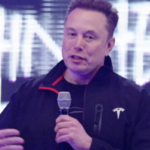
Tesla CEO Elon Musk has just announced that millions of the company’s vehicles will not be able to use full self-driving capabilities due to hardware requirements.
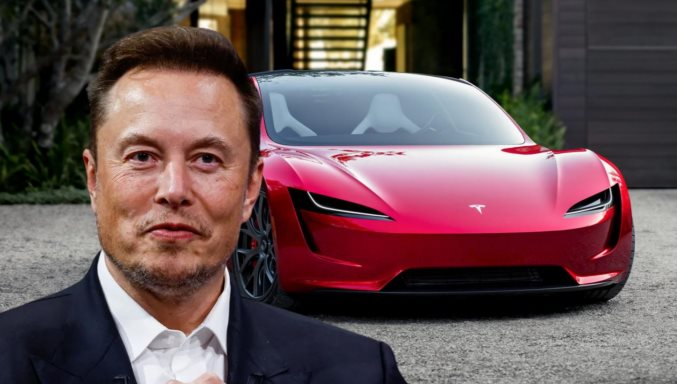
Tesla’s promise of fully autonomous driving (FSD) has faced a major setback, with CEO Elon Musk recently admitting that millions of the company’s vehicles, manufactured between 2019 and 2023, will not be able to feature this capability due to hardware requirements.
Specifically, Tesla’s Hardware 3 (HW3) driver assistance technology only supports supervised autonomous driving. This means the car can perform complex driving maneuvers such as self-driving on the road, automatic parking, and remote vehicle dispatch, but still requires human supervision to handle unexpected situations.
Previously, Tesla had advertised that the HW3’s computing system was powerful enough to run FSD simply through a software update and pledged to provide this feature to customers.
However, Musk explained that the memory bandwidth (RAM data transfer speed) on HW3 is much lower than on Hardware 4 (HW4), which was introduced in 2023.
“HW3 simply doesn’t have the power to run full autonomous driving without human supervision. We once thought HW3 could do that, but it only has one-eighth the memory bandwidth of HW4,” Musk said.
To enable older vehicles using HW3 to run FSD, both the processing computer and the camera system need to be upgraded, a costly and time-consuming process for vehicle owners.
Faced with millions of affected vehicles, Elon Musk proposed several solutions. He suggested Tesla implement trade-in programs with significant discounts for owners of older models, allowing them to upgrade to newer models at a discounted price and use FSD.
Additionally, the billionaire also proposed building “mini-factories” in major cities with a high concentration of Tesla users to perform hardware upgrades for older models.
“If vehicle upgrades were done at Tesla’s service centers, the process would be very slow and inefficient. Essentially, Tesla needs miniaturized production lines to perform hardware upgrades. Older models would be upgraded from HW3 to HW4 to enable full self-driving capabilities,” Musk said.
However, he did not mention the specific timeframe and cost for this upgrade process.
Both supervised and fully autonomous driving features on Tesla vehicles allow users to empower the car with control. The computer system can handle complex driving maneuvers on its own.
However, the core difference lies in legal liability and the level of human intervention. With supervised self-driving, users still have to sit behind the wheel, observe the road, and be ready to intervene if unexpected problems arise. When an accident occurs, the driver will be held legally responsible if the fault is determined to be with their vehicle.
Conversely, the fully autonomous driving feature allows Tesla vehicles to control themselves without human intervention. Users can do anything, including sleep, while the car is moving. In this case, Tesla would be legally responsible if an accident occurs.
It is expected that the fully autonomous driving feature will not be equipped on Tesla models that meet the hardware requirements (using the HW4 system) until the fourth quarter of 2026.
News
Michael Kim responded to Stephen A. Smith’s “terrible” comments about the PGA Tour: “You should just stick to making important comments about the NFL and NBA.”
Kim’s points cut to the core of what Smith perhaps missed As Saudi Arabia’s fund confirmed it was pulling LIV…
Fans React to Scottie Scheffler’s Heated Exchange, Urge Him to Emulate Jordan Spieth
Scottie Scheffler Under Fire After ‘Hostile’ Media Moment, Jordan Spieth Held Up as Standard. Golf analyst Jamie Kennedy did not…
Kim Kardashian’s response to critics over daughter North West’s extreme looks
Kim Kardashian’s daughter has a new music track, which sees her donning even more controversial studs Kim Kardashian has responded…
Kim Kardashian’s Skims brand is being sued by a small designer for “brand imitation.”
Kim Kardashian’s Skims sued by small New York designer over ‘copycat’ name Kim Kardashian’s Skims brand is being sued by…
Alex Zanardi dies aged 59 as motorsport mourns a champion who refused to be defined by tragedy
The former Formula 1 driver, two-time CART champion and Paralympic gold medallist passed away on May 1 Alex Zanardi’s story…
Lewis Hamilton’s optimism has once again given way to familiar disappointment.
Lewis Hamilton admits Ferrari upgrade hope faded fast in Miami Sprint Qualifying Lewis Hamilton arrived in Miami with reason to believe Ferrari might…
End of content
No more pages to load