Following a series of incidents involving SpaceX rockets, Elon Musk’s role in the goal of returning humanity to the Moon for the first time in over 50 years is being questioned.

Hours before sunrise, SpaceX engineers were filling the latest version of Starship’s upgraded Super Heavy rocket with nitrogen. In an instant, the rocket broke apart and cracked, spewing thick smoke across the Boca Chica launch pad in Texas.
SpaceX says no one was injured in an “unusual incident” that occurred in late November during structural testing for Elon Musk’s giant rocket.
But this is the latest setback affecting Starship’s development as SpaceX races to prepare its rocket to return humanity to the Moon for the first time in over 50 years – completing a key goal of Donald Trump ‘s second presidential term .
In early 2025, the 122-meter-long Starship experienced three consecutive incidents.
During one test, an explosion shortly after takeoff forced aircraft over the Caribbean to divert to avoid the path of burning debris. In June, a rocket exploded on the launch pad, damaging the pad.
In August and October, the company regained some momentum with two tests proceeding as planned. The next few months will be crucial to getting Starship back on track, with the next flight expected in early 2026.
The race with China
NASA has planned for SpaceX to send humans to the Moon in 2027 on a mission called Artemis III, ahead of competing efforts from China. This would be the first time humans have set foot on the Moon since 1972.
But delays in the Starship project and the complexity of the mission NASA is planning are making the timeline increasingly tight.
Philip Lucas, a professor at the Centre for Astrophysics Research at the University of Hertfordshire, said: “It’s clear that the Artemis III program will be delayed. The earliest that could happen is probably late 2028, which is quite plausible.”
The next crucial phase of NASA’s lunar exploration program, Artemis II, will take place in February 2026.

Debris from a SpaceX rocket, launched in Texas, has forced planes over the Caribbean to divert their flights. Photo: Marcus Haworth/Reuters.
The American Space Launch System rocket, built by a consortium of aerospace companies at enormous cost, is preparing for a crewed flight past the Moon as a rehearsal for returning humans to the lunar surface.
That mission will pave the way for NASA’s launch of Artemis III, with the participation of SpaceX.
But Artemis III will be a much more complex project.
This plan proposes sending astronauts to the Moon using the Space Launch System. They would then transfer to an improved version of Starship – the Human Landing System (HLS) – in orbit around the Moon, before landing on the lunar surface aboard Musk’s spacecraft.
SpaceX operates on the principle of rapidly testing its rocket designs, launching multiple prototypes to accelerate the Apollo program. If some tests fail, that’s part of the process.
But unlike the Apollo missions of the 1960s and 1970s, getting Starship to the Moon wouldn’t be a single launch. The HLS launch system, much larger than Apollo’s Eagle lander, wouldn’t be able to reach orbit and carry enough fuel to the Moon in a single launch.
Instead, the 240,000-mile (386,242 km) journey will require rockets to transport fuel to Starship’s HLS system as it orbits Earth, before finally making its trip. This mission would require approximately 12 successful launches of Musk’s heavy rockets to complete.
The rationale behind using Starship to go to the Moon is that, one day, the system could be completely reused. Starship would be capable of performing multiple missions to the lunar surface, significantly reducing costs.
According to SpaceX, this advanced rocket will help humanity “establish a lasting presence on the surface of the Moon, not just flags and footprints.”
However, there have been calls for NASA to reconsider its approach.
In September, at a Senate hearing, Jim Bridenstine, a former NASA administrator, warned that the mission was “extremely complex” and suggested that “it is highly unlikely we will land on the Moon before China.”
That month, a NASA safety panel warned that SpaceX’s lunar lander risked being “delayed by years” and stated that the program was “facing significant challenges.” At a meeting this month, the panel urged NASA to “reconsider mission goals” for Artemis III.
The big competitor to SpaceX
SpaceX was first awarded a contract to build a lunar lander in 2021, worth $2.9 billion .
But in October, Sean Duffy, NASA’s acting director, said he would “reopen the contract” and “allow other space companies to compete with SpaceX.” Musk responded by calling him “Sean Dummy” in an X-rated post.
The biggest beneficiary could be Blue Origin, run by Jeff Bezos, Musk’s rival. Blue Origin has been developing its own lunar spacecraft, intended for use in future Artemis missions.
In December, Duffy was replaced by Jared Isaacman, a former SpaceX astronaut and friend of Musk, as head of NASA.
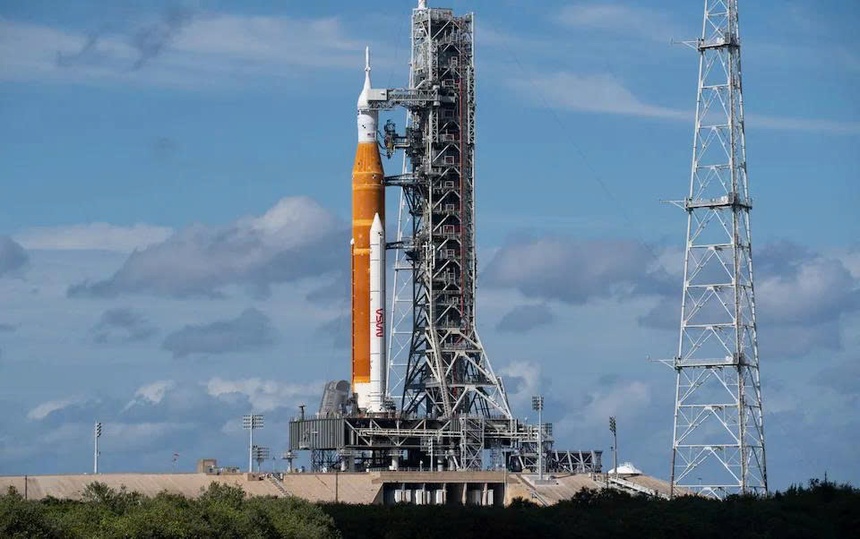
If the Artemis III project proceeds as planned, astronauts will travel to the Moon aboard NASA’s Space Launch System. Photo: Joel Kowsky/NASA.
However, in an interview with Bloomberg , Isaacman still left open the possibility of considering alternatives to SpaceX.
He said, “I think both providers are well aware that whichever lander is available first to ensure the U.S. achieves its strategic objectives on the Moon will be our choice.”
His appointment on December 18th was followed by a new executive order from Trump, requiring a return to the Moon by 2028 and the establishment of a “permanent outpost on the Moon” by 2030.
This order also requires a swift review of programs that are “more than 30% behind schedule,” along with “planned mitigation or remediation efforts.”
“The reality is that if humans want to go to the Moon by 2028, they won’t be able to do it just by relying on the ambitious Starship-based approach,” said Tim Farrar of the technology research firm TMF Associates.
In October, both SpaceX and Blue Origin submitted plans to NASA for what they described as a “simplified” mission to accelerate Artemis III development. Unlike SpaceX’s rocket, the second stage of Bezos’s New Glenn spacecraft is designed to be replaceable in a single go.
In November, Dave Limp, CEO of Blue Origin, told Ars Technica: “If NASA wants to speed things up, we will do everything we can.”
“Interestingly, in recent months, Blue Origin has been trying to break into this market. They’ve had a lot of success with New Glenn. People often underestimate them,” Farrar said.
The coming weeks could be crucial.
While SpaceX prepares for new Starship tests, Blue Origin is on its own mission, carrying a robotic version of its own-built lunar lander, scheduled for launch next February.
Lucas, from the Center for Astrophysics Research, said the 2028 deadline “isn’t entirely crazy, it’s entirely achievable.”
He added that the benefit of attempting to use Starship is that the U.S. could achieve “long-term heavy cargo delivery capability” to the Moon, far surpassing the “Apollo” launch type. A fully operational Starship could pave the way for permanent lunar bases and other future facilities.
But if Trump is looking for a quick victory by returning Americans to the surface of the Moon, then Musk could be in trouble.
“Would anyone dare say to the president, ‘I’m sorry, we can’t land in 2028’?” Farrar asked.
News

Brianna Chickenfry continues to criticize Zach Bryan’s marriage to Samantha Leonard, claiming it was solely driven by…’hatred’.
Brianna Chickenfry Says Zach Bryan’s Marriage Was “All a Dig at Me” The post-breakup drama between Brianna Chickenfry and Zach…

It’s a Boy Again! Luke Combs and Nicole Welcome Baby No. 3
The Combs family just got a little bigger and a lot sweeter. Luke Combs and his wife, Nicole, have welcomed…

Carrie Underwood has faced a ‘storm of criticism’ regarding her politics and her stance on “standing on the right side of history”.
Carrie Underwood ‘American Idol’ boos spark firestorm, fans clash over MAGA and ‘right side of history’ claims Country star faces…

Kid Rock ‘asks’ God to punish those who tarnish his ‘honor’.
“Sooner Or Later, God Will Cut ‘Em Down”: Kid Rock Calls Out “Liberal Media” & Clarifies Pricing On His ‘Freedom…

Lee Greenwood is facing significant public backlash in the US after being accused of “FRAUD”.
Country Icon Slammed For Selling $100 Bibles Online: “Grift Never Stops” Lee Greenwood appeared on “Fox & Friends” reminding everyone…

Erika Kirk, CEO of Turning Point USA, was full of praise for Kid Rock’s performance: “Charlie will definitely love it.”
Erika Kirk sides with Kid Rock after disastrous MAGA performance in statement Charlie Kirk’s widowed wife Erika Kirk shared a…
End of content
No more pages to load