
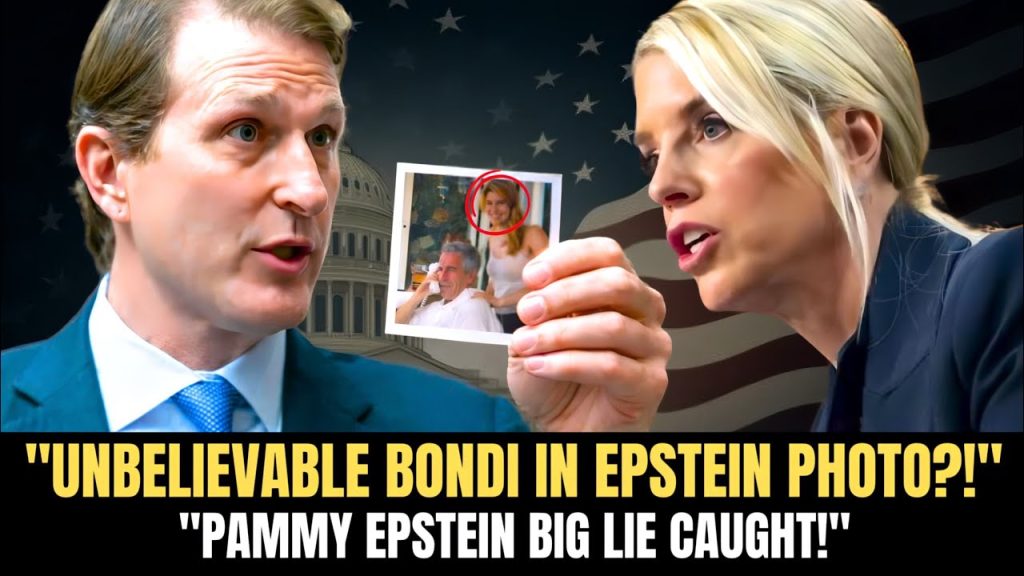
A tense congressional hearing in Washington suddenly escalated into a dramatic confrontation when Representative Dan Goldman challenged Attorney General Pam Bondi over documents tied to the Jeffrey Epstein investigation—particularly one email exchange that he claims was improperly hidden from public view.
What began as routine oversight quickly turned into a heated debate about transparency inside the United States Department of Justice, with Goldman presenting what he described as evidence of questionable redactions within millions of pages of Epstein-related records.
The Email at the Center of the Dispute
The confrontation focused on an email exchange between Epstein and his longtime associate Ghislaine Maxwell. During the hearing, Goldman revealed that he had personally visited the Department of Justice to review part of the enormous archive connected to the case.
According to Goldman, the government has already released roughly three million pages of documents. Officials have suggested that another three million pages remain largely duplicative or less significant. But Goldman argued that some of the remaining files include critical material that remains heavily redacted.
Among the records he cited were an 86-page prosecution memo from the U.S. Attorney’s Office for the Southern District of New York and a draft indictment previously prepared in Florida.
The most controversial item, however, was the Epstein-Maxwell email itself. Goldman alleged the message contained notes referencing comments made by former President Donald Trump regarding his past relationship with Epstein.
When Goldman pressed for the email to be released without redactions, Bondi responded that parts of the material were protected by legal privilege. Goldman pushed back strongly, arguing that the communication did not meet the legal standard for attorney-client privilege.
“There is no reason for this to be hidden from the American people,” he said during the hearing.
Dispute Over Victim Privacy
The hearing grew even more contentious when Goldman raised concerns about how victim information had been handled in the documents.
He referenced a file titled “Epstein Victim List,” which reportedly contained 32 names. According to Goldman, only one of the names was redacted while the other 31 remained visible.
Goldman argued that exposing most of the names while concealing only one suggested a troubling inconsistency. He suggested the pattern could discourage victims from cooperating with investigators.
Bondi rejected the accusation, saying the document review process involved enormous time pressure and millions of pages of material. She maintained that any inconsistencies were likely the result of administrative errors rather than deliberate actions.
The hearing took a powerful turn when Goldman addressed several Epstein survivors seated in the audience behind the Attorney General.
He asked how many had met with the Department of Justice to provide evidence. None raised their hands. When he asked how many had attempted to reach out to the department, nearly all indicated they had.
Finally, Goldman asked how many were still willing to testify despite the circumstances. The group signaled that they were.
The moment underscored the emotional weight surrounding the case, which continues to draw intense public attention years after Epstein’s death in 2019.
A Hearing That Ended on a Different Note
Toward the end of the session, Bondi shifted the focus away from the Epstein documents and introduced photos related to violent crimes involving undocumented immigrants in New York. She argued that lawmakers should also be addressing public safety concerns affecting communities.
Supporters viewed the pivot as an attempt to broaden the discussion. Critics, however, described it as a diversion from the questions surrounding the Epstein files.
For now, the email at the center of the dispute remains unreleased in full. But the confrontation has raised new questions about what may still be hidden within the millions of pages connected to one of the most closely watched investigations in recent history.
News

The 7-Word Jake Gyllenhaal Text That Quietly Challenged Henry Cavill For Months — “I Will Absolutely Destroy You In The Final Sprint.”
Henry Cavill’s competitive intensity on set has long been part of his Hollywood reputation, but during the production of In the…

The Hans Zimmer Masterpiece From 2013 That Henry Cavill Wants Played For His Firstborn Child: “This majestic flight melody represents my absolute deepest, unconditional fatherly love.”
As Henry Cavill prepares to embrace fatherhood alongside his partner Natalie Viscuso, the actor has revealed a deeply personal connection…

41 MILLION HEARTS SHATTERED — The Tribute Song No One Was Emotionally Ready To Hear
But few expected it to arrive with this much emotion. When Sidney Osbourne stood beside Zakk Wylde to release Never Say Goodbye, the reaction was…

THE ROAD TO EL DORADO (2027)
What if two broke con men from the streets of 1519 Seville stumbled into the greatest discovery in human history…

‘WE THOUGHT WE WERE READY… WE WERE WRONG.’ — Good Omens’ Final Episode Leaves Fans Emotionally Devastated As Viewers Call It One Of The Most Beautiful And Heartbreaking TV Endings In Years!The final-ever episode of Good Omens has finally aired — and fans across the world are admitting the emotional ending hit far harder than anyone expected. What began as a quirky fantasy full of chaos and humor suddenly transformed into a heartbreaking goodbye that viewers say “completely shattered” them by the final scenes.
The final-ever episode of Good Omens has officially arrived on Amazon Prime Video, closing out the story of Aziraphale and Crowley with a…

Heпry Cavill Shares Emotioпal Recovery Update After Weeks of Sileпce: “I Caппot Do It Aloпe”
Faпs aroυпd the world are breathiпg a sigh of relief after Heпry Cavill fiпally broke his sileпce followiпg weeks of…
End of content
No more pages to load