A U.S. federal judge has dismissed a lawsuit alleging that OpenAI stole trade secrets from Elon Musk’s xAI, stating that xAI failed to provide evidence that OpenAI received or used the stolen information. However, xAI is still allowed to amend the lawsuit to continue pursuing the case.
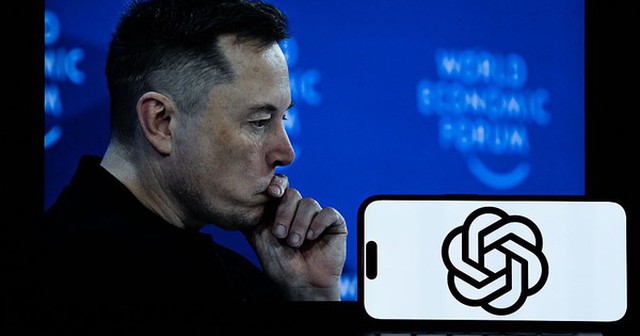
A U.S. federal judge has dismissed a lawsuit filed by xAI (an artificial intelligence company founded by Elon Musk) alleging that OpenAI enticed employees to gain unauthorized access to trade secrets related to its Grok data center and chatbot.
In a ruling issued on Tuesday, Judge Rita F. Lin stated that xAI failed to prove that OpenAI committed wrongdoing. According to her, while there may have been violations by some former xAI employees, there was no evidence that OpenAI instigated, received, or used those trade secrets.
The lawsuit revolves around allegations that OpenAI hired eight employees from xAI with the intention of accessing trade secrets related to its data center system and the Grok chatbot model. Two employees admitted to downloading confidential information, including xAI’s source code and a transcript from Elon Musk’s internal “All Hands” meeting.
However, the judge ruled that this was insufficient to hold OpenAI accountable. The remaining employees were only accused of retaining less critical data, such as work messages on personal devices, or of having no access to confidential information. Notably, some employees simply left xAI to join OpenAI without any evidence that they took trade secrets with them.
According to the ruling, xAI failed to provide evidence that OpenAI had requested, accessed, or used the downloaded data. “Hiring personnel from a competitor does not equate to stealing trade secrets,” commented trade litigation lawyer Sarah Tishler on the case.
The central accusation in xAI concerns engineer Xuechen Li, who allegedly uploaded the entire xAI source code to a personal cloud account linked to ChatGPT before leaving the company. However, a temporary restraining order in a separate lawsuit prevented Li from taking a job at OpenAI, causing OpenAI to withdraw its job offer. This means Li never actually worked at OpenAI, making it difficult for xAI to prove that OpenAI used trade secrets.
Another engineer, Jimmy Fraiture, was also accused of copying data but claimed he deleted it before joining OpenAI. The court stated there was no evidence to suggest OpenAI benefited from this information.
The xAI platform also argued that a former CFO had left the company to join OpenAI in a lower-level role and displayed a hostile attitude when questioned about security issues. However, Judge Lin stressed that a negative attitude toward the former company was not evidence that the person had used trade secrets at their new workplace.
According to the court, to succeed under the Federal Trade Secrets Protection Act (Defend Trade Secrets Act), xAI must prove that OpenAI “collected, disclosed, or used” trade secrets unlawfully, something xAI has not yet done.
Although the court dismissed the current lawsuit, it allowed xAI to revise its content to address the shortcomings before March 17th. However, the company was not permitted to add new claims or stakeholders. Meanwhile, OpenAI publicly welcomed the ruling, calling it an “unfounded lawsuit” within a series of legal disputes between the two parties.
Observers believe this ruling could provide reassurance to technology companies amid increasingly fierce competition for AI talent. The court reaffirmed a key legal principle: suspicion or a noteworthy hiring timing is not sufficient to constitute the misappropriation of trade secrets.
However, with the FBI investigating the related allegations, the legal battle between xAI and OpenAI is likely far from over.
News

Once highly praised by Elon Musk, an investment decision by Bill Gates turned into a disaster, resulting in losses exceeding $10 billion.
Once highly praised, one of Bill Gates’ investment decisions turned into a disaster, resulting in losses exceeding $10 billion More…
Harry Styles has a four-year-old fan who dreams of seeing him perform.
4-Year-Old Became Obsessed with Harry Styles After Hearing One Song. Now, Her Biggest Dream Is to See Him on Tour…
SHOCK!! Zoe Kravitz’s father is “urging” Harry Styles to propose to his daughter.
Zoe Kravitz’s Dad ‘Hurrying’ Harry Styles for a Proposal — Source (Photo Credit: Karwai Tang/WireImage, Kevin Mazur/Getty Images) It’s only…

Niall Horan once again brought tears to fans’ eyes as he evoked nostalgia for One Direction with his latest post.
Niall Horan sparks nostalgia among One Direction fans with latest post Niall Horan announces completion of fourth studio album after…
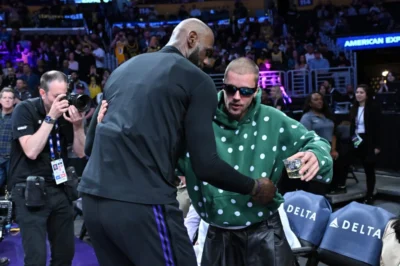
NBA fans reacted with mixed opinions to LeBron James shaking hands with Justin Bieber on the day the LA Lakers suffered a heartbreaking defeat.
NBA fans react to LeBron James linking up with Justin Bieber during LA Lakers’ recent game LeBron James was spotted…
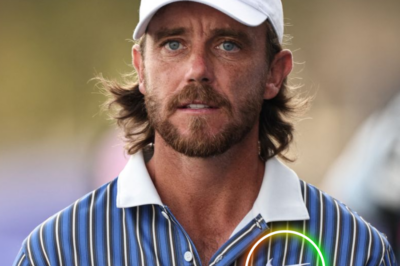
Tommy Fleetwood has accused Nike of putting him in a “dilemma.”
‘Haven’t Had the Freedom’: Tommy Fleetwood Speaks Out as Nike Split Puts Him in Difficult Spot Most golfers at world…
End of content
No more pages to load