
A new tool called Halftime can make characters in old movies and series unexpectedly switch to introducing a brand new product right in the middle of a scene.

Elon Musk and his artificial intelligence company xAI have sparked considerable controversy by introducing a tool capable of “embedding” AI-generated advertisements directly into movies and television shows, instead of inserting them during breaks like traditional commercials.
Amidst complaints about the frequency and inconspicuous insertion of ads on streaming platforms, xAI claims to have a new approach. According to the company, its tool, called “Halftime,” can “dynamically weave” AI-generated ads directly into the scenes the user is watching. The idea is that instead of cutting to a separate commercial, Halftime adjusts the on-screen visuals of the characters, causing them to temporarily leave their original dialogue to hold, use, or introduce a product chosen by the advertiser.
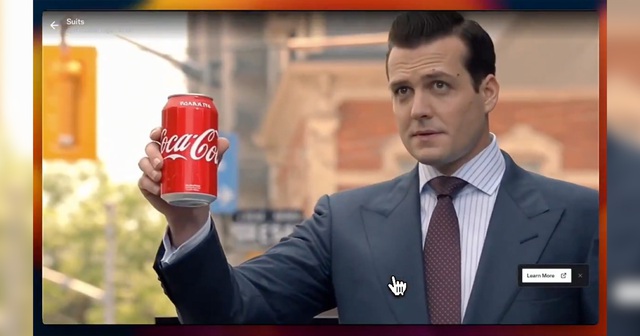
Advertisements are inserted directly into the film scene thanks to AI “manipulating” the characters – Photo: xAI
xAI describes Halftime’s goal as making “breaks” “part of the story” rather than annoying interruptions. A demo video released by xAI shows how the tool works with popular movies and series. In one episode of the legal drama “Suits,” Harvey Specter’s character suddenly stops mid-sentence, holds up an AI-generated Coca-Cola can to the camera, and poses as if filming a commercial.
Another example is in the series “Friends,” where the character Joey suddenly reaches for a new pair of Beats headphones and puts them on with a look of delight. This detail becomes a clear “time shift,” because “Friends” began airing in the mid-1990s, a time when Beats headphones did not yet exist.
In both cases, the content viewing interface has an “learn more” button inserted on the screen. When viewers click it, they are taken directly to the relevant product page. When they return to the video content, the AI-generated advertisement immediately disappears, and the scene returns to its original state as if it had never been “interfered with,” like a bad dream that just passed.
Despite being launched as a product introduced by xAI, Halftime was not actually developed by the company’s internal team. The tool is the result of a group of three University of Waterloo students who participated in a recent hackathon organized by xAI in San Francisco.
In a LinkedIn post, Krish Garg, co-author of Halftime, said his team won the competition for “making ads invisible.” He described Halftime as software that can “create real-time, personalized cutscenes and product placements tailored to each viewer’s preferences.”
However, beyond the confident pronouncements, the potential repercussions of this technology for the film and television industry are causing widespread concern. Filmmakers have long warned about tech corporations “devouring” and distorting art with AI-powered content that mimics classic works.
With Halftime, this concern is taken even further: in theory, an actor—along with the character they play—could be “reused” to promote products they’ve never heard of or agreed to be associated with. Some argue this mirrors real-life stories where actors sold the rights to their images to AI companies, only to later discover their faces were being used for controversial purposes, such as appearing in content deemed to promote coups abroad.
It’s not hard to understand why Halftime faced such a strong backlash on social media. One prominent post encapsulated this outrage with the phrase: “Hey man, burn everything down please.” Many other users compared xAI’s tool to satirical science fiction works about media manipulation, such as John Carpenter’s film “They Live” or David Foster Wallace’s novel “Infinite Jest.”
Beyond ethical and artistic criticism, many argue that Halftime is actually going against its own promise. Instead of becoming a natural part of the story or even “invisible,” these commercials are considered distracting and disrupt the viewing experience even more than traditional commercials.
Some commentators borrowed the classic observation of critic Roger Ebert, who once called cinema an “empathy machine”—a machine that helps people experience and understand the emotions of others. According to them, technologies like Halftime are turning that “empathy machine” into an “AI-powered product advertising machine.”
However, there is no guarantee that Halftime will be integrated into major streaming platforms or widely used in the content industry. Many believe that this tool may remain merely a sensational student project. Copyright issues alone are considered complex enough to be a major obstacle, as editing, inserting new content, and exploiting images and actors’ performances from released works for advertising purposes is a legally complex matter.
But as many observers have ironically noted, whether legal hurdles and copyright disputes are enough to deter AI companies remains an open question, given how the industry has developed over the past period.
News

The country music star shared an update on her health after being rushed to the hospital with sepsis.
‘I was rushed to hospital with sepsis… the hardest part of all is the mum guilt’ – country music star…

Adam Levine bitterly shared that he was “hurt” because Blake Shelton had “ruined” him on The Voice.
Adam Levine Vents About How Blake Shelton “Ruined” Him on The Voice: “He’s Wounded Me” The Voice Season 29 Coach…

“Like father, like son”… Kid Rock’s son, Robbie Ritchie, lives a more luxurious life than we imagine.
Kid Rock’s Son Robbie Ritchie Lives A More Lavish Life Than We Realized After many years under the radar, Kid…

Country music star denied entry into Canada due to ‘criminal past’.
Country Star Forced to Cancel Entire Tour After Being Denied Entry to Canada It’s an incident from 2014 that seems…

Eric Benét bluntly criticized Jelly Roll, calling him a coward who only speaks nonsense.
Eric Benét Says Jelly Roll Is ‘Full of Sh–‘ for Refusing to Comment on Politics at 2026 Grammys: ‘It’s You…
Justin Bieber saw a Rolls-Royce concept that the company refused to make for him until one garage decided to take it into their own hands
When Justin Bieber caught a glimpse of a Rolls-Royce concept that he wanted, but Rolls-Royce refused to make, a garage…
End of content
No more pages to load