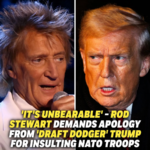
Rod Stewart called on President Donald Trump to apologize for his disparaging remarks about NATO troops, exhorting British Prime Minister Keir Starmer and Leader of Reform UK Nigel Farage to also put pressure on the “draft dodger.”
Stewart addressed his ex-friend in a recent Instagram video, which you can see below.
What Did Rod Stewart Say to Trump?
“Hi there. I may just be a humble rock star. I’m also a knight of the realm, and I have my opinions,” Stewart said. “I was born just after the war [World War II], and I have great respect for our armed forces that fought and gave us our freedom. So it hurts me badly, deeply, when I read that the draft dodger Trump has criticized our troops in Afghanistan for not being on the front line.
“We lost over 400 of our guys,” Stewart continued. “Think of their parents. Think about it. And Trump calls them almost like cowards. It’s unbearable. So I’m calling on you, Prime Minister Starmer and Farage, please make the draft dodger Trump apologize. Please. Thank you.”
What Did Trump Say About NATO Troops?
Trump once again invited controversy and made international headlines with his flippant remarks about NATO in a Thursday interview with Fox News in Davos, Switzerland.
“I’ve always said, ‘Will they be there, if we ever needed them?’” Trump said of NATO. “And that’s really the ultimate test. And I’m not sure of that. I know that we would have been there, or we would be there, but will they be there?”
The president continued, discussing NATO’s involvement in the wake of the 9/11 terrorist attacks: “We’ve never needed them. We have never really asked anything of them. You know, they’ll say they sent some troops to Afghanistan, or this or that. And they did – they stayed a little back, a little off the front lines.”
Of the roughly 3,500 allied troops who died in Afghanistan, the U.S. lost the most of any country with 2,456 fallen soldiers. There were also 457 were British troops killed — the second-largest total per country and almost the same amount in terms of relative population, according to CNN.

Vinyl Records
Rod Stewart – Foot Loose & Fancy Free
How Did International Politicians React to Trump’s NATO Comments?
Trump’s NATO comments drew swift condemnation from international politicians, including Prime Minister Starmer.
“I consider President Trump’s remarks to be insulting and frankly appalling, and I’m not surprised they’ve caused such hurt for the loved ones of those who were killed or injured,” Starmer said on Friday.
When asked if he would demand an apology from Trump, Starmer stopped just short of doing so, saying: “If I had misspoken in that way or said those words, I would certainly apologize.”
The famously unapologetic Trump seemingly walked back his NATO comments on Saturday with a complimentary Truth Social post.
“The GREAT and very BRAVE soldiers of the United Kingdom will always be with the United States of America!” he wrote. “In Afghanistan, 457 died, many were badly injured, and they were among the greatest of all warriors. It’s a bond too strong to ever be broken. The U.K. Military, with tremendous Heart and Soul, is second to none (except for the U.S.A.!). We love you all, and always will!”
16 Rock Stars Who Served in the U.S. Military
A salute to veterans who served their country.
Gallery Credit: Allison Rapp
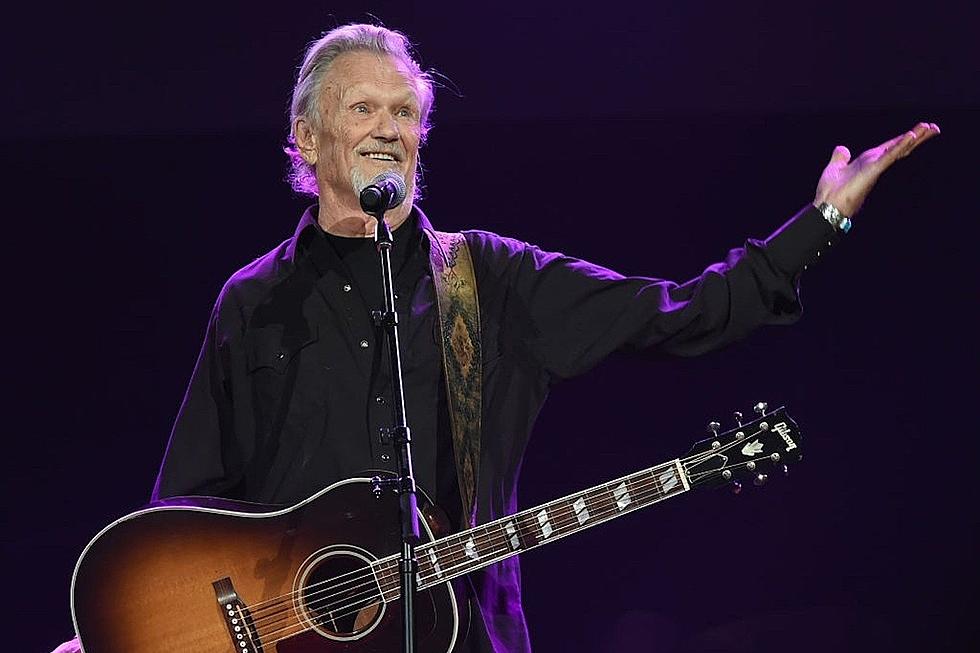
Kris Kristofferson
Rick Diamond, Getty Images
Kris Kristofferson
Kris Kristofferson’s life path took several turns before he ended up as one of the most accomplished songwriters of his generation. The son of a two-star Air Force general, Kristofferson first studied at Oxford under a Rhodes Scholarship before joining the U.S. Army and rising to the rank of captain. After completing a tour in Germany in 1965, he was offered a teaching position at West Point, which he declined in order to pursue a musical career in Nashville. “I’m kind of amazed by the whole thing,” he told Rolling Stone in 2016. “I was on my way to a totally different life. And all of a sudden I committed my future and all my family and everything to this! It was pretty scary.”

Ray Manzarek
Chris Walter, Getty Images
Ray Manzarek
Several years before he became an outspoken critic of the Vietnam War, Doors cofounder and keyboardist Ray Manzarek enlisted in the Army Signal Corps in 1962, hoping to work as a camera operator. But he was assigned to the Army Security Agency at a base in Japan as a prospective intelligence analyst instead. But Manzarek didn’t sign the proper security clearances. “It was because he was of Polish descent and wanted to be able to visit the old country one day, after he got out of the Army,” Manzarek’s friend at the base, Britt Leach, later wrote. Poland was then a Communist country and was off-limits to intelligence personnel. Manzarek was eventually granted a discharge and enrolled in film school at UCLA, where he met his future bandmates.

Willie Nelson
Archie Carpenter / Getty Images
Willie Nelson
After graduating high school in 1950, Willie Nelson joined the Air Force and served nine months before being medically discharged due to back issues. “I was in the Air Force a while and they had what they call ‘policing the area.’ That’s where you looked around and if there’s anything wrong here, there, anywhere, you took care of your own area,” Nelson told Military.com. “And I think that’s a pretty good thing to go by. If everyone just takes care of their own area, then we won’t have any problems. Be here. Be present. Wherever you are, be there. And look around you and see what needs to be changed.”

B.B. King
Larry Busacca, Getty Images
B.B. King
A young B.B. King enrolled in the Army in 1943 in the middle of World War II. He was sent home shortly afterward because he drove a tractor back home in Mississippi, an essential home-front occupation during the war. There, he continued to appear on local radio stations and developed a growing fan base.

John Prine
Tom Hill, Getty Images
John Prine
Singer-songwriter John Prine had been working as a mailman when he was drafted into the military in 1966 during the Vietnam War. He was stationed in West Germany, where he worked as a mechanical engineer. Upon his return, Prine channeled some of his overseas experiences and thoughts on the ongoing war into songs like “Your Flag Decal Won’t Get You Into Heaven Anymore” and “Sam Stone,” a song about an addiction-riddled veteran who arrives home from service a changed person.

John Fogerty
Kevin Winter, Getty Images
John Fogerty
In 1966, three years before the release of “Fortunate Son,” John Fogerty entered a military recruiter’s office around the time his draft number came up. He signed up with the U.S. Army Reserve as a supply clerk. He then went through basic training at Fort Bragg, N.C., and soon found himself stationed at Fort Knox. Fogerty then spent six months on active duty and remained in the reserves until 1968. “There’s a lot of insight that you learn about getting along with people and what is the mindset inside the military,” he told Fort Knox News in 2019. “You really do learn how to discipline yourself and be part of a team that helps make things flow, because that’s part of your job.”

Johnny Cash
Hulton Archive, Getty Images
Johnny Cash
Like many young men of his generation, Johnny Cash enrolled in the Air Force when he was 18. Following basic training, he was assigned to the 12th Radio Squadron Mobile of the U.S. Air Force Security Service in Landsberg, West Germany, where he worked as a Morse code operator intercepting Soviet transmissions. “The Air Force taught me the things every military service imparts to its enlisted men,” Cash wrote in his 1997 autobiography, “plus one skill that’s pretty unusual: If you ever need to know what one Russian is signaling to another in Morse code, I’m your man.” (While located in Germany, he formed his first band, the Landsberg Barbarians.) After four years of service, he was honorably discharged as a staff sergeant and returned to the States.

Harry Belafonte
YouTube
Harry Belafonte
After dropping out of his New York City high school, singer Harry Belafonte enlisted in the U.S. Navy in 1944 and served during World War II, though he was never sent overseas. Afterward, he utilized the veterans G.I. Bill to cover the cost of a drama workshop in Manhattan — the first step toward his career in show business. He was soon performing on stages and singing in popular nightclubs across New York, landing his first record deal in 1949.

Elvis Presley
National Archives, Getty Images
Elvis Presley
When Elvis Presley entered the Army in 1958, he was at the height of his popularity. He was offered a chance to enlist in Special Services to entertain the troops but was persuaded by his manager to instead serve as a regular soldier, a decision that earned him the respect of not only his fellow military men but older folks back home who viewed him and his music as a threat on America’s youth. “I had quite a few interesting experiences: slept out in the snow, ate through rations,” Presley said in a post-service news conference. “I suppose the biggest thing is that I did make it. I tried to play it straight like everybody else. I made a lot of friends that I wouldn’t have made otherwise. All in all, it’s been a pretty good experience.”

Maynard James Keenan
Steven Ferdman, Getty Images
Maynard James Keenan
Tool front man Maynard James Keenan enlisted in the Army right out of high school in 1984. He did well in training but turned down an offer to continue work at West Point. “When I joined the military, I was pretty convinced that all of that crap was over. I believed we kind of found some kind of groove as far as world peace,” he told Rolling Stone in 2016, noting that the lessons he took away from his service came mostly from the connection and discipline he experienced shoulder-to-shoulder with other soldiers. “The growth that occurs in those spaces where you’re just broken down and then being built back up – there’s a lot to be said for those kind of things.”

Jimi Hendrix
Hutton Archive, Getty Images
Jimi Hendrix
Jimi Hendrix was faced with a choice in 1961: spend two years in prison for stealing cars or join the Army. He chose the latter and enlisted in May 1961. After basic training, he was assigned to the 101st Airborne Division and stationed at Fort Campbell, Ky. He asked his father to send his guitar, which he had left behind in Seattle. Some of his fellow soldiers made fun of his musical habit, but others joined in as Hendrix and performed at base clubs on weekends. But Hendrix’s overall disinterest in the military and lackadaisical attitude led to his honorable discharge in 1962.

Jason Everman
YouTube
Jason Everman
Jason Everman (left in the above photo) played in two of the most influential grunge bands of all time, joining Nirvana as a guitarist in 1989 before playing bass in Soundgarden. But in 1994 he steered his life in a different direction. “At that point in time, in the world I was in, going into the military was probably the most uncool thing you could ever do,” he said in 2014. Nevertheless, Everman enlisted in the Army and ended up serving multiple tours in Afghanistan and Iraq. He received an honorable discharge in 2006 and still goes overseas regularly, working as a military consultant. He also formed an all-veterans band called Silence & Light that released an album in 2019.

Jerry Garcia
dead.net
Jerry Garcia
Like Jimi Hendrix, Jerry Garcia, chose the military over prison time for stealing cars. But, like Hendrix, he didn’t take to his new life and was discharged less than a year after his enrollment in 1960. Still, the experience widened his horizons. “I lasted nine months in the Army,” Garcia told Rolling Stone in 1972. “I was at Fort Ord for basic training, and then they transferred me to the Presidio in San Francisco, Fort Winfield Scott, a beautiful, lovely spot in San Francisco, overlooking the water and the Golden Gate Bridge and all that, and these neat old barracks and almost nothing to do. It started me into the acoustic guitar; up until that time I had been mostly into electric guitar, rock ‘n’ roll and stuff.”

Bill Withers
Michael Putland, Getty Images
Bill Withers
Eager to leave his small West Virginia hometown, Bill Withers enlisted in the U.S. Navy at age 17. President Harry Truman had desegregated the military in 1948, but Withers soon discovered a thick layer of prejudice remained. “My first goal was I didn’t want to be a cook or a steward,” he told Rolling Stone. “So I went to aircraft-mechanic school. I still had to prove to people that thought I was genetically inferior that I wasn’t too stupid to drain the oil out of an airplane.” Withers stayed in the Navy for nine years; he credited the experience with helping him overcome a childhood stutter. He was discharged in 1965.

Artimus Pyle
Jason Kempin, Getty Images
Artimus Pyle
Artimus Pyle played drums for Lynyrd Skynyrd from 1974 until 1977, and then again from 1987 to 1991. But before that, he’d been a successful avionics mechanic at multiple military bases – he’d joined the Marines in 1968 and eventually worked his way up to the rank of sergeant before being honorably discharged in 1971.

Toy Caldwell
YouTube
Toy Caldwell
Toy Caldwell was best known for being a founder and the lead guitarist for the Marshall Tucker Band from its inception in 1972 up until 1983. Prior to that, though, he had been a member of the U.S. Marine Corps and was wounded in Vietnam in September of 1968. He was discharged in 1969 and started playing music with local friends not long after…
Read More: Rod Stewart Slams ‘Draft Dodger’ Trump for Insulting NATO Troops | https://ultimateclassicrock.com/rod-stewart-trump-nato-apology/?fbclid=IwY2xjawPll6NleHRuA2FlbQIxMABicmlkETFkMko5bEpoa3duSmhhYjhKc3J0YwZhcHBfaWQQMjIyMDM5MTc4ODIwMDg5MgABHsajVSok2B9feOOgsMVSnjRdwhyuxQQsOU2TKhkHucX9eSJKNSQNuuCiYqKS_aem_K8ZGSRMz9vxayJPsEe-4Vg&utm_source=tsmclip&utm_medium=referral
News
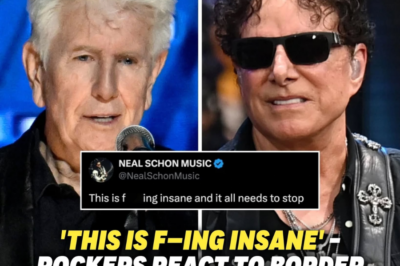
Rockers React to ‘Insane’ Border Patrol Killing of Alex Pretti
Graham Nash, Neal Schon, Tom Morello and other rock stars took to social media to react to a Border Patrol agent fatally shooting…
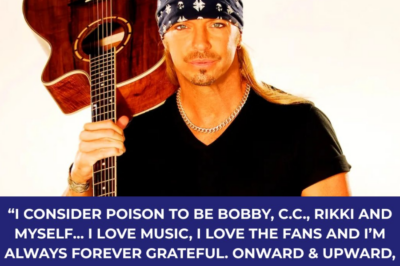
Bret Michaels Reacts After Poison Drummer Claims 40th Anniversary Tour Wasn’t Happening Due to Frontman’s Financial Demands
Michaels broke his silence in a Facebook post on Jan. 21 after Rikki Rockett alleged that the bandleader wanted $6…
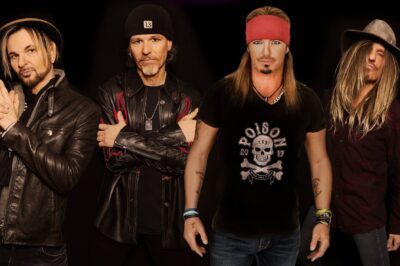
BRET MICHAELS Breaks Silence On POISON Tour Rift After RIKKI ROCKETT’s Pay Dispute Claims
BRET MICHAELS Breaks Silence On POISON Tour Rift After RIKKI ROCKETT’s Pay Dispute Claims As rumors swirl over a stalled…
Listen to Def Leppard’s hard rocking new song ‘Rejoice’
“We love it. It’s hard rock for us. It’s got a bit more of an ‘oomph’ than stuff we’ve been…

“Besides her huge breasts, what else does she have? I can wear a headscarf and still attract attention. That’s the power of the eye.” Bella Ramsey criticized Sydney Sweeney for relying on her looks to get roles, claiming Sydney’s acting was SOULLESS.
A remark attributed to Bella Ramsey about beauty, attention, and acting standards recently circulated online, quickly igniting debate across entertainment…
Truth behind the viral claim that Will Smith is returning to the Oscars
Truth behind the viral claim that Will Smith is returning to the Oscars Rumors claiming that Will Smith’s Oscars ban…
End of content
No more pages to load