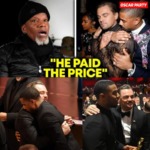
DL Hughley has ignited a firestorm in Hollywood after suggesting that Michael B. Jordan’s Oscar win came at a cost — one that involved public humiliation at the hands of the very institution that ultimately handed him the gold statue.
The comedian and radio host didn’t attack Jordan personally. Instead, he leveled a blistering critique at the Academy Awards system itself, describing what he calls a ‘humiliation ritual’ that Black actors must endure before being rewarded.
‘Whether it’s the Oscar committee or a grand jury, whenever people meet in secret, the results ain’t going to be good for Black people,’ Hughley tweeted, encapsulating a sentiment he has expressed for years.
Hughley has long been skeptical of awards shows, arguing that Black audiences shouldn’t ‘beg white people to love and accept us.’
But his latest comments come in the wake of a deeply uncomfortable incident at the BAFTAs just weeks before Jordan’s Oscar win — an incident that Hughley and others believe was anything but coincidental.
Jordan was on stage at the British awards ceremony alongside co-star Delroy Lindo, presenting an award, when a man in the audience with Tourette syndrome shouted the n-word.
‘Delroy and I are delighted to be presenting the first BAFTA of the night for a vital part of movie making,’ Jordan began, before the slur rang out.
The man who shouted has Tourette’s, and some have argued the outburst was an unfortunate coincidence. But critics point to a troubling detail: the BAFTAs were pre-recorded with a two-hour delay, meaning producers had ample time to edit the slur out of the broadcast.
‘If he yelled a slur at a certain other group of people, the BBC would have cut it with zero hesitation,’ one observer noted. ‘So why did they leave it in? What was the purpose of letting two Black actors be humiliated like that in front of millions around the globe?’
Neither Jordan nor Lindo addressed the incident on stage. Lindo later told reporters he wished someone from BAFTA had spoken to them afterward. Jordan remained silent.
Then, weeks later, he won an Oscar.
‘And this is what DL means by a humiliation ritual,’ a source close to Hughley’s thinking explained to DailyMail.com. ‘First, you’re publicly degraded. Then, the same institution that failed to protect you hands you a gold statue, and you’re expected to smile and thank them. It’s like they’re testing you. Can you take the humiliation and still play nice? Can you be a good Black actor who doesn’t make waves?’
Hughley’s critique taps into a long and painful history between Black performers and the Academy Awards — one that goes all the way back to the very first Black Oscar winner.

Hattie McDaniel made history in 1940 when she won Best Supporting Actress for her role as Mammy in ‘Gone with the Wind.’ But on the night of the ceremony, she was forced to sit at a segregated table at the back of the room, away from her white co-stars.
When McDaniel died of cancer in 1952, she requested to be buried at Hollywood Forever Cemetery. The cemetery denied her request because it was segregated. For decades, her grave went unmarked until the cemetery finally placed a memorial monument in 1999.
‘And Hattie was making the same choice Black actors make today,’ Hughley suggested. ‘Take the degrading role and hope it leads somewhere better. But for Hattie, it didn’t. She spent her career fighting for scraps.’
More than eight decades later, Hughley argues, little has changed.
Halle Berry became the first — and still only — Black woman to win Best Actress in a Leading Role when she took home the Oscar in 2002 for ‘Monster’s Ball.’ The film required Berry to play a Black woman who falls in love with a racist prison guard who executed her husband.
‘What did Halle’s win actually change?’ Hughley asked.
Berry herself has admitted she thought the win would lead to more opportunities and more meaningful roles. Instead, she got ‘Catwoman.’
‘I thought, “Oh, I’m going to get lead roles here and there,”‘ Berry later reflected.
Lupita Nyong’o won Best Supporting Actress in 2014 for ’12 Years a Slave’ — a film about a free Black man who is kidnapped and sold into slavery.
‘After I won that Academy Award, you know, you think, oh, I’m going to get lead roles here and there,’ Nyong’o said. ‘Oh, Lupita, we’d like you to play another movie where you’re a slave, but this time you’re on a slave ship. You know, those are the kinds of offers I was getting in the months after winning my Academy Award.’
For Hughley, the pattern is clear: Black actors are rewarded for playing trauma, degradation, and suffering — often at the hands of white characters — and then expected to be grateful.
‘Black actors can perform in white stories and win Oscars for playing slaves, maids, and tragic figures whose entire existence revolves around white people,’ he argued. ‘But actually telling your own stories and controlling the narrative — that’s where Hollywood draws the line.’
The statistics back up his argument.
In the entire 96-year history of the Academy Awards, not a single Black director has ever won Best Director.
John Singleton made history in 1991 as the first Black director ever nominated for ‘Boyz n the Hood.’ He didn’t win.
Lee Daniels was nominated for ‘Precious.’ He didn’t win.
Steve McQueen was nominated for ’12 Years a Slave.’ He didn’t win.
Barry Jenkins was nominated for ‘Moonlight’ in 2016. He lost to Damien Chazelle for ‘La La Land.’
Spike Lee, one of the most influential filmmakers in American history, didn’t receive his first Best Director nomination until 2019 for ‘BlacKkKlansman.’ He didn’t win.
‘Now, think about what that means,’ Hughley said. ‘Black actors can perform in white stories and win Oscars. But actually telling your own stories — that’s where Hollywood draws the line.’
Hughley also pointed to a pattern he observed with Will Smith, who campaigned for years for an Oscar before finally winning in 2022 — on the same night he slapped Chris Rock on live television.
‘DL watched Will Smith campaign hard for years only to finally win after slapping another Black man at the same ceremony,’ one observer noted. ‘The humiliation was built right into the moment.’
When it comes to Jordan, some have noted that the actor has carefully cultivated a public image that avoids controversy.
Unlike his predecessor Michael Jordan — who famously said ‘Republicans buy sneakers, too’ when asked about endorsing a Black political candidate — the younger Jordan has been described as ‘safe’ by Hollywood standards.
‘Watch his interviews or go back through his public statements and you’ll notice he doesn’t have strong opinions on anything — not on anything that might ruffle feathers,’ a source familiar with the industry told DailyMail.com. ‘And even when the BAFTAs allowed a man to shout the n-word at him, Michael still said nothing.’
Some fans have drawn direct comparisons to the basketball icon’s approach.
‘That’s exactly why Hollywood loves Michael B. Jordan,’ the source added. ‘He’s talented enough to carry a franchise and safe enough that he’ll never make anyone uncomfortable. He’ll never use his platform to say anything that might cost him the next role.’
Hughley’s critique also extends to the types of stories Hollywood celebrates.
From ‘The Blind Side’ to ‘Green Book’ — a film about a Black genius who exists primarily to teach a white driver something about himself — the white savior narrative remains a favorite formula for packaging Black stories for white consumption.
Dr. Tionne Alliyah Parris, a professor of Africana Studies, recently published a critique of Jordan’s Oscar-winning film ‘Sinners,’ arguing it pushes a ‘false vision of empowerment.’
According to the professor, the movie suggests ‘the solution to oppression is simply for Black people to realize their power’ — ignoring that ‘personal empowerment cannot actually change systems rooted in economic exploitation.’
For Hughley, the point isn’t to diminish Jordan’s achievement but to question what the achievement actually represents.
‘Some of you watching might be thinking, “It’s not that deep. Why can’t we just be happy for Michael B. Jordan?”‘ he acknowledged. ‘And I get it. On the surface, it’s a big deal. A talented Black actor gets recognized by the biggest award in Hollywood. But here’s the thing: celebrating individual wins while ignoring the systemic issues is not the way forward.’
Representatives for Michael B. Jordan, DL Hughley, and the Academy of Motion Picture Arts and Sciences did not immediately respond to requests for comment.
As one observer put it: ‘Getting a seat at a table after you’ve been publicly humiliated is not progress.’
News
Kid Rock responds to Conan O’Brien’s ‘alternate Oscars’ joke
Kid Rock wasn’t a fan of Conan O’Brien’s “alternate Oscars” joke from Sunday’s Academy Awards. The joke, which O’Brien made…
Jonathan Bailey Reflects on Growing Up Gay, How It Affected His School Life: ‘I Felt Really Scared and I Felt Alone’
Jonathan Bailey is recalling how his sexuality shaped his formative years. PEOPLE’s Sexiest Man Alive opened up to Sky News about his experience growing…
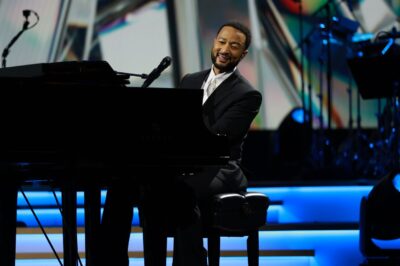
“They said it wouldn’t work.” — John Legend ditched effects for a single piano at the Grammys, and the minimalist “All of Me” moment left the show’s producer speechless.
The Sound of Silence: When John Legend’s “Minimalism” Shattered the Spectacle The Staples Center on January 26, 2014, was a…
“I’ve waited my whole life to play this” — John Legend stunned the Grammys honoring Aretha Franklin’s 60-Year Legacy; his soulful piano revived a Queen’s spirit.
In 2018, the stage of the Grammy Awards transformed into something far beyond a performance venue. It became, as Alicia…
Inside John Legend’s $17.5M Beverly Hills Sanctuary with a Bespoke 500-Bottle Wine Room and a Sun-Drenched 10,700-Square-Foot Open Floor Plan Unveiled.
Perched in the hills of Beverly Hills, the private residence of John Legend and Chrissy Teigen stands as more than…

SEE John Legend brave a 100-degree Arizona desert to play 1 acoustic piano for 500 detained migrants, proving his relentless pursuit of justice needs no arena.
Under the unforgiving Arizona sun, where temperatures pushed past 100 degrees, the atmosphere outside the Eloy Detention Center felt less…
End of content
No more pages to load